
Imagine a traveller planning a safari in Kenya. They are comparing the Masai Mara, Amboseli, and other destinations, checking itineraries, and deciding which operator feels right for their trip. Before sending an enquiry, they want clear answers about what is included, who will guide them, and how they can contact the company.
Your business may offer knowledgeable guides, comfortable safari vehicles, and carefully planned itineraries. But if visitors cannot find those details quickly, they may choose another operator whose website answers their questions more clearly.
For Kenya safari tour operators, a website is more than a digital brochure. It introduces your business, presents your experiences, communicates credibility, and helps travellers decide whether to enquire.
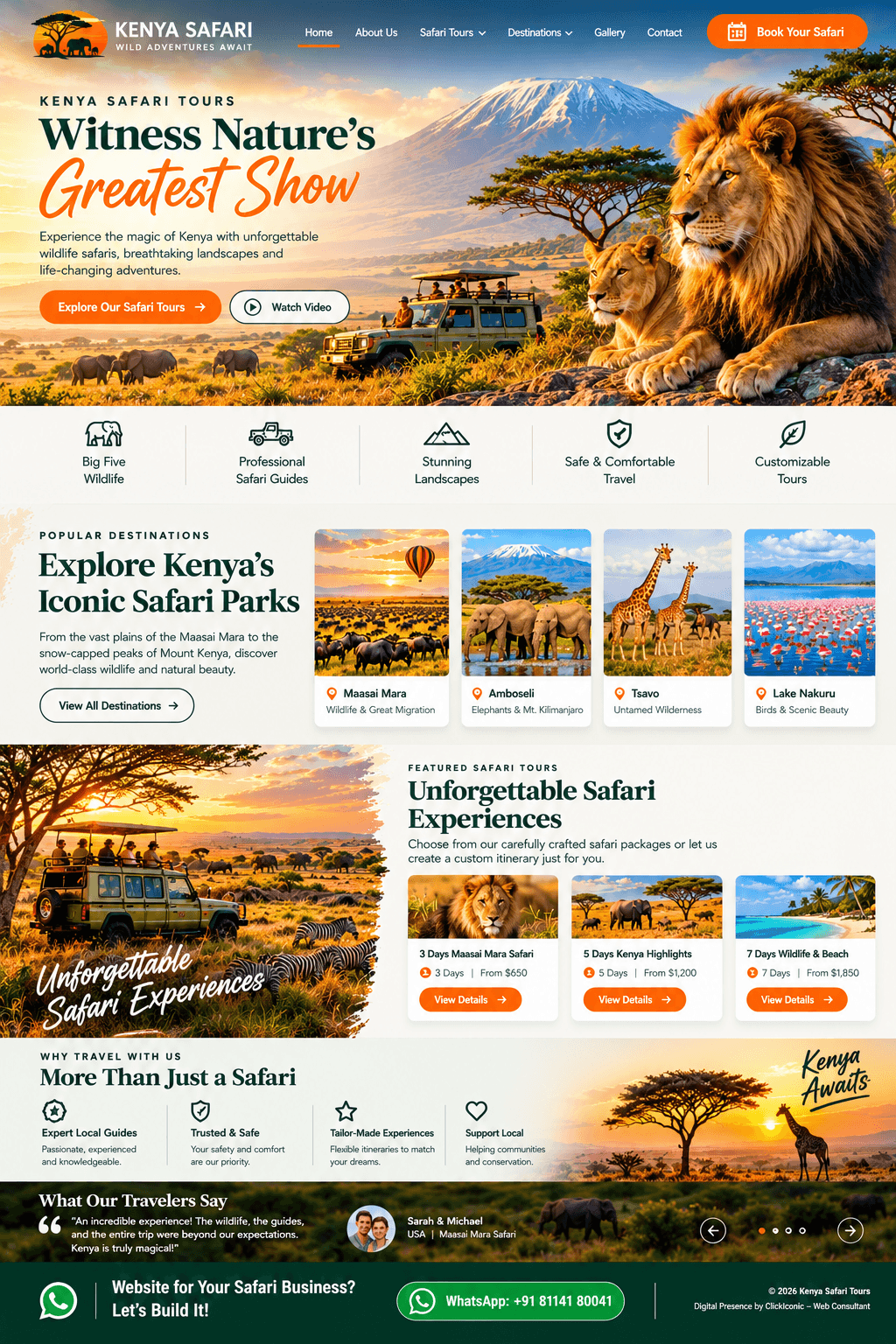
A professional Kenya Safari Website Design should combine genuine wildlife photography, clear safari packages, useful destination information, and straightforward enquiry options. Visitors should understand what you offer without having to search through several pages.
Whether you organise Masai Mara wildlife safaris, guided game drives in Amboseli, tours across Tsavo, or customised journeys throughout Kenya, your website should reflect the real quality and character of your experiences.
ClickIconic helps travel and service businesses plan professional digital experiences with clear positioning, considered design, mobile usability, and practical enquiry journeys.
Planning a new website or looking to improve your existing one? Explore our website design examples to see how a professional digital presence can help your travel business build trust and attract enquiries. Visit our showcase or contact ClickIconic to discuss your website requirements.
Make a Strong First Impression With Your Safari Website
When someone visits your safari website, they should quickly understand what experiences you offer, where you operate, and how to start planning a trip.
A visitor interested in Kenya wildlife tours should not have to search through several pages to discover whether you organise game drives, multi-day safaris, private tours, or customised itineraries.
Your homepage should combine a clear headline, relevant wildlife photography, a concise introduction, and a visible enquiry action. These elements help visitors understand your offering without unnecessary effort.
A company specialising in private Masai Mara tours should communicate that focus from the beginning. An operator covering several parks may need a broader introduction supported by clear destination links.
Professional safari website design should reflect your actual business instead of looking like an interchangeable travel template.
Make Your Safari Experience Clear From the Start
Review the first screen of your homepage. Can visitors identify your services, destinations, and next step? If not, simplify the message and make your main enquiry action easier to find.
Showcase Wildlife Safaris and Game Drive Experiences
Wildlife is one of the strongest visual assets a safari business can present. Travellers want to imagine the landscapes, animals, guides, and experiences they may encounter during a trip.
A wildlife safari website design should use relevant, high-quality images that accurately represent the destinations and services being offered. Photography can communicate the atmosphere of a safari, the vehicles used, and the landscapes visitors may explore.
Images should support useful information rather than replace it. Explain where each experience takes place, how long it lasts, what it includes, and what travellers should know before enquiring.
If your business offers morning and afternoon game drives, full-day excursions, private safaris, or multi-day tours, present the options clearly so visitors can compare them.
Avoid promising guaranteed wildlife sightings. Explain the natural environment and the opportunities for wildlife observation while setting realistic expectations.
A well-presented game drive website helps potential guests understand your experiences before they contact your team.
Use Photography to Tell the Safari Story
Choose images that accurately represent your destinations, vehicles, guides, and experiences. Pair important photographs with useful tour information so visitors understand what makes each experience worth exploring.
Present Safari Packages and Itineraries Clearly
Travellers researching safari packages often compare several operators. They need to understand trip duration, destinations, accommodation, activities, and the overall experience included in each package.
A page displaying only a package name and a photograph may not provide enough information for a serious enquiry. Dedicated itinerary pages can answer common questions and help visitors decide whether a trip suits them.
Each package page can include the duration, destination route, day-by-day itinerary, accommodation category, transport arrangements, meals, inclusions, exclusions, and a clear option to request a quotation.
Depending on your actual services, you could organise separate collections for private safaris, budget tours, luxury experiences, family holidays, photographic safaris, or short game drives.
You do not necessarily need a complex booking system to start receiving enquiries. A clear itinerary page with a quotation form or WhatsApp contact option may be a practical starting point.
The goal is to give travellers enough information to understand the experience and help your team prepare a relevant response.
Make Every Safari Package Easy to Understand
Use a consistent structure for your itineraries. Include essential trip details, accurate inclusions and exclusions, relevant photographs, and a clear enquiry action.
Create Dedicated Kenya Safari Destination Pages
Kenya offers a variety of wildlife and nature experiences. Your website can help travellers explore the destinations you serve by giving important locations their own informative pages.
Depending on your actual tour routes, these pages might cover the Masai Mara National Reserve, Amboseli National Park, Tsavo East and Tsavo West, Nairobi National Park, or other destinations in your itineraries.
A useful destination page explains what makes the location distinctive, which experiences your company offers there, and how the destination fits into your tours.
For example, an Amboseli page could discuss elephant viewing opportunities and views of Mount Kilimanjaro when conditions permit. A Masai Mara page could explain wildlife experiences and seasonal considerations relevant to your tours.
Original destination information can support search visibility when it answers genuine traveller questions. Someone researching a private Masai Mara safari should be able to find a relevant page rather than a homepage that mentions every destination briefly.
Only promote destinations and experiences your business can genuinely arrange. Keep descriptions accurate and avoid unsupported promises about wildlife sightings or seasonal conditions.
Build Pages Around the Destinations You Actually Sell
Start with the parks and reserves that feature most often in your tours. Give each destination a useful introduction, relevant itineraries, authentic imagery, and a clear enquiry route.
Build Trust With Genuine Information and Evidence
Travellers may research your company from another country, sometimes months before departure. They need reasons to feel comfortable sharing their travel requirements and discussing a significant purchase.
Explain who operates the business, how travellers can contact you, where you work, and which safari services you provide. If you have experienced guides, relevant qualifications, local partnerships, or a genuine track record, present those strengths accurately.
Genuine testimonials can help travellers understand other customers' experiences. Specific feedback about communication, guides, accommodation, or the overall safari is more useful than unsupported claims about being the best operator.
Clear information about inclusions, exclusions, cancellation terms, payment arrangements, and the enquiry process can reduce uncertainty.
Make contact details easy to find. A working enquiry form, professional email address, and clearly presented WhatsApp option give visitors convenient ways to approach your business.
Trust depends on consistency. A beautiful homepage cannot compensate for outdated tour information, broken links, unanswered forms, or promises the business cannot support.
Let Visitors See the Business Behind the Safari
Introduce your company, explain your experience, display genuine customer feedback where available, and provide clear business and contact information. Keep important details accurate and up to date.
Make Safari Enquiries and Booking Requests Easy
Not every traveller is ready to book a fixed package immediately. Some are comparing dates, travelling with children, planning a honeymoon, or looking for a private safari combining several destinations.
Your website should support these different needs. Visitors may want a quotation, availability information, a customised itinerary, or answers about a particular game drive.
An enquiry form can collect travel dates, the number of travellers, preferred destinations, trip duration, accommodation preferences, and special requirements. Keep the form focused on details your team needs to respond helpfully.
WhatsApp provides another convenient contact route. A well-placed button can help visitors start a conversation about a package without searching for your number.
If you want travellers to confirm tours or pay online, booking and payment functionality can be discussed as part of the project scope. An enquiry-based website may be more suitable for operators who customise most itineraries.
Choose a process that matches the way your safari business actually sells tours.
Choose the Right Enquiry Journey for Your Business
Decide whether your main goal is to receive quotation requests, answer questions through WhatsApp, accept booking requests, or process confirmed bookings online. Make the relevant action clear across your website.
Make Your Safari Website Work on Mobile
Travellers may discover your business through Google, social media, referrals, or a shared link. Many will open your website on a smartphone before deciding whether to explore it further.
A mobile-friendly safari website should make text easy to read, navigation straightforward, photographs appropriately sized, and contact buttons easy to use.
Visitors should be able to browse packages, read itineraries, explore destinations, and submit enquiries without repeatedly zooming in or struggling with an overcrowded layout.
If a website loads slowly, hides important information, or makes contact difficult, potential guests may leave before learning about your services.
Responsive design should adapt to different screen sizes while maintaining a clear presentation. Optimised images, accessible information, and practical forms all contribute to a smoother experience.
For operators sharing website links through social media or digital campaigns, a good mobile experience is especially important.
Test the Complete Journey on a Smartphone
Open your website on a phone. Find a safari package, understand its itinerary, and contact your team. If any step feels difficult, simplify the layout or improve the relevant page.
Improve Visibility With Safari Website SEO
Potential guests may search for Kenya safari tours, private wildlife safaris, Masai Mara itineraries, or Amboseli game drives. Your website structure should reflect the services and destinations that matter to your business.
Start by mapping each important service to a page that answers a real traveller question. A safari tour website may include focused pages for packages, destinations, private tours, and game drives rather than placing every topic on the homepage.
Search wording varies. Some customers search for Kenya wildlife tours or game drive tours Kenya. Others search for a Masai Mara safari website, Kenya travel website design, or safari website redesign because they are researching providers or improving their own business website. Use each phrase only where it fits the page's purpose.
A safari company website design project may include Kenya safari website development, wildlife tour website design, or an African safari website design approach that reflects the company's actual services. Phrases such as game drive website design, custom safari website design, and safari website designer should be used naturally rather than repeated to increase keyword frequency.
A business planning a safari booking website or safari packages website should explain whether visitors can request a quotation, submit a booking request, or pay online. Related terms such as tour operator web design and safari website design company should appear only where relevant.
Place the primary keyword, Kenya Safari Website Design, in prominent and appropriate locations such as the page title, introduction, and relevant headings. Include secondary phrases naturally in the article, but avoid keyword stuffing.
Technical foundations matter too. Clear navigation, descriptive URLs, mobile-friendly layouts, optimised images, meaningful internal links, and appropriate metadata help search engines understand a website.
SEO does not guarantee rankings or enquiries. Competition, content quality, website authority, technical performance, and many other factors affect results. However, useful original content and a well-planned structure give your website a stronger foundation.
Build Your Website Around Real Traveller Searches
Identify the destinations, experiences, and packages that matter most to your business. Create focused pages that genuinely help travellers research those topics, then support them with clear navigation and appropriate SEO foundations.
Show What Makes Your Safari Business Different
Many safari companies promote guided tours, wildlife experiences, and trips through Kenya's national parks. If your website communicates only general promises, visitors may struggle to understand why they should choose your business.
Your difference might be private safaris, flexible itineraries, family-friendly experiences, photography-focused trips, specific destinations, or a particular accommodation style. It may also be the way your guides support guests or help them plan a customised route.
Explain who your tours are designed for, what makes the experience distinctive, and how travellers can discuss their requirements.
A business focused on luxury experiences will need a different presentation from an operator offering affordable group tours. Let your real specialisation guide the homepage, package categories, imagery, and supporting content.
Do not invent a unique selling point. Identify what your business genuinely does well and communicate it clearly.
Make Your Real Strengths Visible
Write down the three things customers value most about your safari business. Use those points to guide your homepage message, package presentation, and supporting content.
Know When Your Safari Website Needs a Redesign
Your business may have added packages, new destinations, or improved its services. If your website still presents an earlier version of the business, it may no longer communicate your capabilities accurately.
An outdated design can make important information difficult to find. Package details may be incomplete, images may no longer represent your service, and contact options may be difficult to use on mobile devices.
Another warning sign is a website that attracts visitors but receives few meaningful enquiries. The problem may involve unclear messaging, limited itinerary information, weak trust signals, poor mobile usability, or a difficult enquiry process.
A redesign should address these practical problems rather than simply changing colours and photographs. Review your page structure, service descriptions, destination pages, mobile experience, and enquiry journey before deciding what needs to change.
The goal is a website that reflects the quality of your safari experiences and makes it easier for suitable travellers to understand and contact your business.
Redesign for Better Communication, Not Just Appearance
Review your existing website from a traveller's perspective. Identify what is unclear, outdated, difficult to use, or missing. A redesign should improve the overall experience and make it easier for suitable travellers to contact you.
Choose a Website Design That Fits Your Safari Brand
Some safari operators prefer an editorial style with large wildlife photographs. Others may prefer a colourful, adventure-focused design or a clean layout that prioritises tour information.
Your design should reflect your audience, services, brand identity, and the experience you want to communicate. A luxury operator may prioritise understated presentation and accommodation details, while an adventure-focused business may emphasise destinations and activities.
You do not need to begin with a fully defined design concept. Reviewing examples can help you identify the layouts, colours, typography, photography styles, and page structures you prefer.
Visit the ClickIconic Website Design Showcase to explore design directions.
Once you have a preferred direction, contact ClickIconic. Share your business details, safari packages, destinations, required pages, and enquiry process so we can discuss a suitable project scope.
Explore Designs Before Starting Your Project
Shortlist the designs that fit your brand at Visit our showcase. Then contact ClickIconic to discuss your safari services, required pages, and enquiry goals.
Turn Website Visitors Into Safari Enquiries
A website should do more than attract attention. It should help visitors move from exploring your safari experiences to taking a meaningful next step.
Some travellers may be ready to request a quotation, while others are still comparing destinations or deciding how long to spend in Kenya. Your website should offer useful next steps for both groups.
A clear call-to-action can invite visitors to enquire about a package, customise an itinerary, ask about a game drive, or contact your team through WhatsApp.
Place relevant actions where visitors need them. A destination page can link to tours in that location, while an itinerary page can offer a direct way to request pricing.
Keep the enquiry process straightforward. Ask only for useful information, explain what happens next where appropriate, and make sure submitted enquiries reach the correct person.
A website cannot guarantee a particular number of leads. However, a clear offer, helpful content, credible presentation, and accessible contact options can create better conditions for meaningful enquiries.
Give Every Interested Traveller a Clear Next Step
Check your homepage, destination pages, and itineraries for relevant enquiry actions. Make it easy for visitors to ask questions, request a customised itinerary, or discuss a package.
What to Look for in a Safari Website Design Partner
Choosing a website designer is an important decision because the finished website will represent your safari business to potential guests.
Look for a partner who takes time to understand your safari experiences, target travellers, destinations, package structure, and the way your business receives enquiries.
The website plan should consider page structure, visual presentation, mobile usability, relevant SEO foundations, and the journey from discovering a tour to contacting your team.
Clarify what is included in the project. The number of pages, package layouts, content requirements, enquiry forms, WhatsApp integration, booking functionality, and ongoing maintenance can all affect the scope.
Not every operator needs an advanced booking platform at the beginning. A well-designed website with clear package information and a reliable enquiry process may be a sensible starting point.
ClickIconic works with travel and service businesses to plan digital experiences that communicate their offerings clearly and make the next step easier for potential customers.
If you are considering a new website or redesign, share your business details, preferred design references, and the main outcomes you want the website to support.
- ✓They take time to understand your safari business and target audience.
- ✓They understand the importance of wildlife photography and clear presentation.
- ✓They can organise safari packages and itineraries logically.
- ✓They can structure destination pages around your actual services.
- ✓They consider mobile usability from the beginning.
- ✓They understand relevant SEO foundations.
- ✓They can provide suitable enquiry forms and contact options.
- ✓They clarify whether booking and payment functionality is included.
- ✓They explain the project scope and deliverables clearly.
- ✓They help create a website that reflects your brand.
Choose a Website Partner Who Understands Your Business
Explain your safari services, preferred design style, target travellers, and enquiry goals before starting. A clear discussion helps establish the right website structure and avoids paying for features you do not currently need.
A good safari website should represent your experiences accurately, answer traveller questions, communicate credibility, and create a straightforward path towards an enquiry.
Give Your Kenya Safari Business a Stronger Online Presence
Kenya safari tour operators offer travellers remarkable wildlife, landscapes, and guided adventures. Your website should communicate the value of those experiences before a potential guest contacts your team.
A professional wildlife safari website brings together engaging photography, well-structured tour packages, informative destination pages, genuine trust signals, mobile-friendly design, and clear enquiry options.
It should reflect how your business operates and make it easy for visitors to understand your experiences, compare relevant options, and ask questions.
Whether you are launching a new safari company, expanding your tours, or replacing a website that no longer represents your business, the right design can provide a stronger foundation for your digital presence.
ClickIconic can help you plan a website around your brand, destinations, safari experiences, and business goals.
Explore website design concepts in our Website Design Showcase, then contact ClickIconic to discuss your safari business, the tours you offer, and the improvements you need.
Your Safari Experiences Deserve a Website That Represents Them
Review the ClickIconic showcase, then contact us with your website, safari services, and priorities. We can discuss a practical structure, design direction, and enquiry journey for your business.
Kenya Safari Website Design Checklist
Frequently Asked Questions
Key Takeaways
- ✓Your website should communicate the quality and character of your Kenya safari experiences.
- ✓A strong homepage helps visitors understand your business quickly.
- ✓Wildlife photography should be supported by accurate, useful tour information.
- ✓Dedicated package and destination pages help travellers explore their options.
- ✓Genuine business information and customer feedback help establish credibility.
- ✓Mobile-friendly design supports a smoother traveller experience.
- ✓WhatsApp and enquiry forms make it easier for visitors to contact your team.
- ✓SEO-friendly content can support visibility for relevant safari searches.
- ✓A redesign should improve the visitor journey rather than just change the appearance.
- ✓The right website structure depends on how your safari business sells tours.
- ✓ClickIconic can help you plan a website around your business and enquiry goals.
Is Your Kenya Safari Website Ready to Turn Visitors Into Enquiries?
Your safari experiences deserve a website that communicates their real value. ClickIconic helps travel and tourism businesses plan professional digital experiences with clear tour presentation, mobile-friendly layouts, and straightforward enquiry options. Whether you need a new safari website or want to improve your existing one, share your business, tours, and website goals with us so we can discuss a suitable direction.
Discuss Your Website Project