
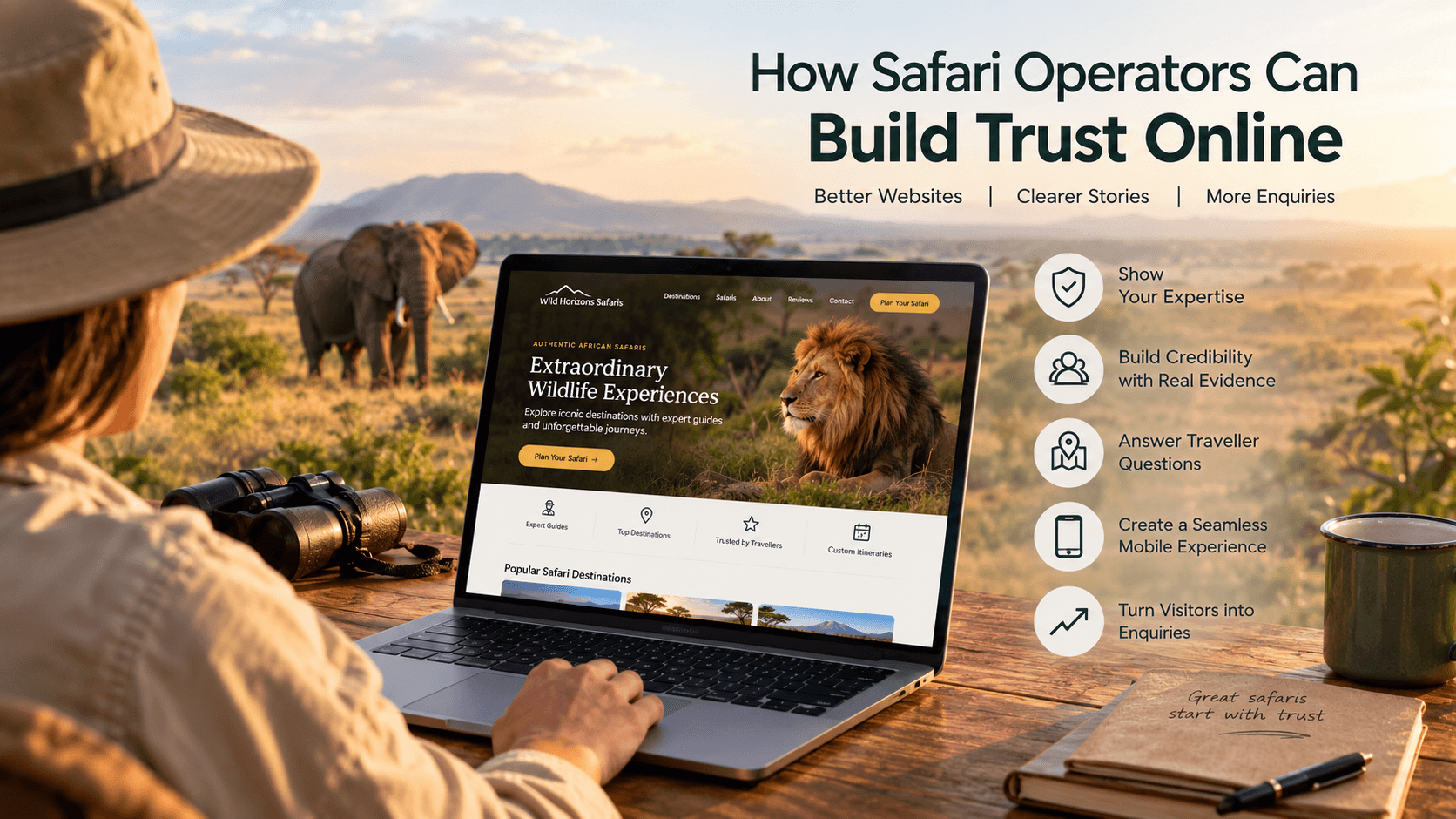
A safari can be an unforgettable experience. For many travellers, it may also be one of the most carefully considered trips they will ever plan.
They may be travelling thousands of kilometres, spending a significant amount of money, and trusting a company they have never met to organise an experience in an unfamiliar destination.
That creates a very important question for every safari operator: Why should a traveller trust your business?
The answer is not always found in the price of the safari or the number of animals shown in your photographs.
It is often built gradually through the information, evidence, experience, and confidence a traveller finds while researching your business online.
For many potential guests, the website becomes one of the first serious places where that judgement happens.
A traveller may discover your company through Google, Instagram, a recommendation, a travel forum, a previous guest, or a destination search. Eventually, many of them will want to see the business behind the safari.
Imagine a traveller comparing three safari operators late at night on a phone. The destinations may look similar. The photographs may all be impressive. What can make one company feel safer to contact is often the detail around those images: clear information, real people, believable experience, and an obvious next step.
They want to understand where you operate, what kind of safaris you offer, who is behind the company, what the experience will actually be like, and whether they can trust you with their trip.
This is why Safari Website Design should not be treated simply as a visual exercise.
A professional safari website needs to communicate the character of the destination while also reducing uncertainty for the traveller.
Beautiful wildlife photography can create desire. Useful information can create understanding. Real reviews and experience can create credibility. A clear enquiry process can turn that confidence into a conversation.
When these elements work together, the website becomes much more than an online brochure.
It becomes part of the safari operator's sales process.
So how can safari operators build trust online?
The answer starts with understanding what travellers need to see, understand, and feel before they are comfortable taking the next step.
1. Start With a Strong First Impression
A traveller does not need to know everything about your safari business when they first arrive on your website.
But they should be able to understand the essentials quickly.
Where do you operate?
What type of safari do you offer?
Who is the safari designed for?
What makes your company worth considering?
These questions should not require visitors to search through several pages.
The homepage should establish the context immediately. A safari business website should make it obvious within moments what the company offers and why the visitor should keep exploring.
A strong hero section can introduce the destination and safari experience through carefully selected imagery, but the visual should work alongside a clear message.
For example, a safari operator working in Tanzania may want visitors to immediately understand that the business specialises in private safaris, migration experiences, family trips, or carefully planned wildlife journeys.
The exact message will depend on the business.
The important thing is that the visitor should not have to guess.
A professional safari website should create an impression of confidence without becoming overly complicated.
The design should feel appropriate to the quality of the safari experience being offered.
That is one of the first jobs of Safari Web Design. The same principle applies whether you are building a new safari travel website or improving an established one.
Make the First Few Seconds Count
Before adding animations, decorative effects, or large amounts of information, make sure the website clearly communicates the destination, safari offer, target traveller, and next step. Strong design should support clarity rather than hide it.
2. Show the Safari Experience, Not Just Wildlife
Wildlife photography is naturally one of the strongest visual assets a safari operator has.
A powerful photograph can make someone stop scrolling and imagine themselves in the destination.
But photographs alone do not explain the safari.
A visitor needs to understand what it feels like to travel with your company.
What happens during a typical day?
How do the guides interact with guests?
Are the safaris private or shared?
What kind of vehicles are used?
What type of accommodation can travellers expect?
How flexible are the itineraries?
What level of support is available before and during the trip?
These details turn a collection of photographs into an experience that visitors can begin to understand.
A strong safari tour website should therefore combine visual storytelling with practical information.
The objective is not to remove the sense of adventure. It is to give travellers enough context to feel comfortable imagining themselves there.
The best websites create desire while still answering the questions that stand between inspiration and enquiry.
Let the Website Tell the Safari Story
Use photography, video, itinerary details, destination information, guide profiles, accommodation details, and guest experiences together. Each element should help visitors understand what travelling with your company actually feels like.
3. Demonstrate Real Safari Expertise
Travellers are not only buying accommodation and wildlife sightings. They are also buying knowledge.
A safari guide's understanding of animal behaviour, seasonal conditions, conservation areas, routes, local communities, and changing conditions can have a major influence on the experience.
That expertise should be visible on the website.
A safari operator website should communicate the knowledge that makes the business valuable. This is especially important for an African safari business competing with operators that may offer similar destinations on paper.
This could include destination guides, seasonal advice, wildlife information, travel tips, guide profiles, conservation initiatives, or explanations of how different safari experiences are planned. These resources can also strengthen a wildlife tourism website by showing useful knowledge rather than relying only on promotional language.
A company does not need to publish an academic textbook.
Even short, useful pieces of information can demonstrate that the people behind the business know the destination beyond what can be found in a generic travel brochure.
This is particularly valuable for an African safari website design project because travellers may be unfamiliar with the destination and need reassurance from someone who understands it.
Expertise is one of the strongest forms of credibility a safari business can communicate online.
Instead of simply saying that you are experienced, give visitors opportunities to see that experience in the way your website explains destinations, wildlife, travel conditions, and safari planning.
Show What You Know
Look at the questions your guides answer every week. Many of those answers can become useful website content. Your knowledge can become one of the strongest reasons a traveller chooses your business.
4. Build Trust With Real Evidence
Trust is easier to build when visitors can see evidence instead of simply reading claims.
A safari company can say that it is experienced, professional, reliable, passionate, or committed to guests.
But these words become more meaningful when the website shows why they are true.
Real guest reviews are one example.
Detailed testimonials can be particularly useful because they explain what travellers actually experienced rather than simply displaying a five-star rating.
The team is another important source of trust.
Introducing guides, safari planners, founders, or local experts can make the business feel more human.
Business information also matters.
Visitors may want to know where the company is based, how long it has operated, how they can contact the team, and who will be responsible for helping them plan their trip.
Relevant memberships, certifications, partnerships, conservation work, or professional affiliations can also contribute to credibility where they genuinely apply.
These are safari website trust signals. They contribute to safari operator credibility because they allow visitors to judge the business from evidence rather than promises.
They should not be added simply to fill space. They should appear where they help answer genuine concerns.
Trust is strongest when the website allows visitors to build their own confidence from real evidence.
Replace Claims With Proof
Review every statement on your website that says your business is experienced, trusted, professional, or different. Ask what evidence you can show beside that claim. Real people, real experiences, and real information are usually more convincing. If you are unsure whether your current website is showing enough proof, a focused review can help you identify the trust gaps before you invest in a full redesign.
5. Answer the Questions Travellers Actually Have
Planning a safari creates a long list of questions.
Travellers may want to know when to visit, what wildlife they can expect to see, how many days they need, what type of accommodation is available, what to pack, how transfers work, whether children can join, what the weather is like, and what happens if plans change.
The questions will vary depending on the destination and type of safari.
The website should reflect those real concerns.
Useful safari website content is not content written simply because a page needs more words. It should support the safari booking experience by helping visitors make decisions with less uncertainty.
For example, a family considering a safari may need very different information from a photographer planning a specialist wildlife trip.
A luxury traveller may be more interested in privacy, accommodation, service, and itinerary flexibility.
A first-time safari traveller may need more guidance about what to expect.
When the website anticipates these questions, the business becomes easier to understand.
It can also improve the quality of enquiries because visitors arrive with a clearer idea of what they want.
The conversation then starts from a stronger position.
Write From Real Customer Conversations
Review the questions your team receives through email, WhatsApp, phone calls, and enquiries. Those questions are valuable content ideas because they already represent the information potential customers need.
6. Make Destinations and Itineraries Easy to Understand
Safari planning can become complicated when destinations, parks, accommodation, transfers, activities, and travel times are presented without a clear structure.
Visitors need to understand how the pieces fit together.
A strong safari website can organise this information through dedicated destination pages and clear itinerary pages. Well-planned safari destination pages and safari itinerary pages can give both travellers and search engines a clearer understanding of what the operator offers.
Safari destination pages can explain what makes a particular park or region interesting, when to visit, what type of wildlife can be seen, and which experiences are available.
Itinerary pages can then show how the overall journey might work.
The objective is not to force every safari into a fixed package. Good safari tourism website design can make custom journeys easier to understand without making the experience feel rigid.
Custom trips can still be presented clearly while allowing visitors to understand the possibilities.
This structure is particularly useful for travellers who are still comparing destinations.
It helps them move from a general interest in 'going on safari' to understanding what type of safari may actually suit them.
Good information architecture also makes the website easier to browse and gives search engines clearer context about the topics covered by the business.
A well-structured safari website can therefore support both the traveller experience and the broader search strategy.
Organise Information Around Traveller Decisions
Do not organise pages only around the way your business is internally structured. Organise them around the decisions travellers need to make: where to go, when to travel, what to experience, what to expect, and how to plan the trip.
7. Make the Safari Website Easy to Use on Mobile
Many travellers research their next trip from a smartphone.
They may discover a safari operator through social media, search results, a recommendation, or a travel article and immediately open the website on their phone.
If the experience becomes difficult on a small screen, confidence can disappear quickly.
Safari website mobile design should therefore be considered from the beginning. A smooth safari website user experience matters because the visitor may be making an important travel decision from a relatively small screen.
Text needs to be comfortable to read.
Menus need to be simple.
Buttons need to be easy to tap.
Images should look strong without making pages unnecessarily slow.
Enquiry forms should not require visitors to complete unnecessary fields.
Contact options should remain easy to find.
This matters particularly for international travellers who may be researching a trip during different stages of their journey.
A website that works smoothly on mobile communicates a level of care that extends beyond the screen. It also supports better safari website performance by making the experience easier to navigate without unnecessary friction.
It tells visitors that the business has considered how they actually use the website.
Test the Website as a Traveller Would
Open your website on a real phone and complete the entire journey yourself. Find a safari, read the details, look for reviews, check the itinerary, find contact information, and submit an enquiry. Anything that feels unnecessarily difficult deserves attention.
8. Build Safari SEO Into the Website
A safari operator cannot build trust with travellers who never discover the business.
Search visibility therefore matters.
Travellers search for destinations, national parks, safari experiences, wildlife, seasons, itineraries, accommodation, activities, and specialist travel information.
A strong safari website SEO strategy helps the website become discoverable for relevant searches while providing useful information once visitors arrive. Good safari website strategy connects search visibility with the real needs of the traveller rather than treating SEO as a separate task.
SEO should not mean filling pages with repeated phrases such as 'safari' or 'Safari Website Design'.
It should begin with understanding what potential travellers are actually searching for.
Destination pages, safari experience pages, useful guides, FAQs, itinerary content, and educational articles can all contribute when they genuinely answer search intent.
Technical foundations matter too. Safari website navigation, page structure, internal linking, and clear content organisation all help create a more useful experience for people as well as search engines.
Important pages should have clear titles, logical headings, descriptive URLs, useful internal links, descriptive image alt text, mobile-friendly layouts, efficient performance, and appropriate indexing controls.
Search engines need to understand the website, but travellers need a reason to stay on it.
Good SEO connects these two requirements.
The goal is not simply to attract more visitors.
The goal is to attract the right visitors and give them useful reasons to continue exploring the business.
Build SEO Around Real Traveller Questions
Before choosing keywords, identify the questions and decisions potential guests are making. Build useful pages around those topics and use relevant keywords naturally within the content, structure, titles, headings, and internal links.
9. Show Why Travellers Should Choose Your Safari Business
Safari travellers often have several operators to compare.
Two businesses may offer similar destinations and even similar itineraries, yet one can feel far more trustworthy than the other.
The difference often comes from positioning. A safari company website should make that positioning visible instead of asking visitors to work it out for themselves.
What does your company understand particularly well?
Who do you serve best?
What kind of safari experience do you create?
What is your approach to guiding, hospitality, conservation, flexibility, or personal service?
A strong website should make those answers visible.
For example, luxury safari website design should communicate more than expensive accommodation. It should communicate the level of service, privacy, personalisation, attention to detail, and overall experience associated with the brand.
Similarly, custom safari website design should make flexibility and personalised planning easy to understand.
A specialist photography safari operator may need to highlight knowledge of wildlife behaviour, light, locations, guides, and photographic opportunities.
The point is not to invent a unique selling proposition.
It is to uncover what is already valuable about the business and present it clearly.
When a website communicates that difference well, visitors have a reason to remember the business instead of treating it as another safari option. A clear position also helps the safari business online feel like a real specialist business rather than another interchangeable travel website.
Make Your Difference Visible
Ask your past guests why they chose you and what they remember most about the experience. Their answers can reveal the strengths your website should communicate more clearly.
10. Make It Easy for Travellers to Enquire
A visitor who has spent time reading your website has already shown some level of interest.
The website should make the next step easy.
That does not necessarily mean asking every visitor to 'Book Now'.
Safari planning is often a considered decision.
A visitor may first want to discuss destinations, understand availability, ask about a family trip, compare itineraries, or request a customised proposal.
The call-to-action should reflect that reality.
Depending on the business, useful actions might include 'Plan Your Safari', 'Request an Itinerary', 'Talk to a Safari Specialist', 'Check Availability', or 'Start Planning'.
The enquiry form should also ask for information that helps the business understand the traveller without creating unnecessary friction.
Travel dates, number of travellers, destination preferences, safari interests, and a short message may be more useful than a long form filled with questions the business can ask later.
The website should also explain what happens after an enquiry is submitted.
Will someone respond within one business day?
Will a safari specialist review the request?
Will the traveller receive a suggested itinerary?
Small details like these can reduce uncertainty.
Good safari website conversion is not about forcing visitors to act. It is about making the safari website enquiries process feel natural and useful when someone is ready to start a conversation.
It is about making a genuine next step feel comfortable.
Make Enquiry Feel Like the Beginning of the Journey
The enquiry process should feel like the first conversation with your safari team, not like a complicated administrative form. Keep it clear, relevant, welcoming, and easy to complete.
11. Know When an Outdated Safari Website Is Holding You Back
A safari business can deliver an excellent experience and still have a website that does not represent it properly.
An outdated safari website may have been built years ago when the business was smaller.
Since then, the company may have added destinations, expanded its team, improved its vehicles, developed new itineraries, received hundreds of guest reviews, or moved towards a more premium market.
But the website may still communicate the old version of the business.
This creates a credibility gap.
A traveller sees a dated website and then has to decide whether the company behind it is as established and professional as the experience being promised.
Visual age is not the only problem.
The website may also have outdated information, poor mobile usability, confusing navigation, slow pages, weak trust signals, unclear calls-to-action, or content that no longer reflects the actual business.
A safari website redesign should therefore be about more than replacing colours and photographs.
It should be an opportunity to reconsider the complete customer journey.
What do visitors need to understand?
Where do they currently hesitate?
What information is missing?
What evidence could create more confidence?
Where should visitors go next?
A redesign becomes much more valuable when these questions are answered before visual design begins. The goal of safari website redesign should be to represent the business more accurately, not simply to make the pages look newer.
Redesign the Experience, Not Just the Appearance
If the business has changed, the website should change with it. Review the positioning, content, structure, trust signals, mobile experience, SEO, and enquiry journey before deciding what the new visual design should look like.
12. What to Do When Your Safari Website Is Not Generating Enquiries
One of the most common frustrations for safari operators is having a website that receives visitors but generates very few enquiries. If your safari website not generating enquiries is the problem you are facing, start by looking for the confidence gap rather than assuming traffic is the only issue.
The immediate assumption is often that the website needs more traffic.
Sometimes it does.
But traffic is only one part of the problem.
If the right people are already reaching the website but leaving without contacting the business, the issue may be somewhere else.
The homepage may not clearly explain the safari offer.
The website may not communicate enough expertise.
Visitors may struggle to understand the itineraries.
Reviews may be difficult to find.
The business may look similar to competitors.
The enquiry process may be unclear.
Mobile users may be experiencing friction.
The content may answer too few traveller questions.
These problems can exist even when the website looks visually attractive.
This is why it is important to review the entire customer journey before simply spending more money on advertising or SEO.
If your safari website is not generating enquiries, ask where visitors are losing confidence.
Do they understand the offer?
Do they understand why they should choose you?
Do they see enough evidence to trust the business?
Do they know what to do next?
The answers can reveal where the website needs improvement.
Find the Confidence Gap
Before trying to generate more traffic, identify what is stopping existing visitors from moving forward. Improving clarity, trust, positioning, content, usability, and the enquiry journey can make the traffic you already have more valuable. If you cannot see where the journey is breaking down, ClickIconic can help review the website from the traveller's point of view and identify the areas that need attention before a full rebuild is considered.
The goal is not to convince every visitor to enquire. The goal is to help the right travellers understand the safari, trust the operator, and feel comfortable starting a conversation.
13. What to Look for in a Safari Website Design Partner
Choosing someone to build or redesign your website is an important decision.
A safari website is not simply a collection of pages and photographs.
It represents the business before a traveller has spoken to anyone on the team.
That means the person working on the website needs to understand more than visual design.
A safari website designer should be able to understand the traveller journey, the destination, the type of safari being sold, the concerns visitors have, and the reasons they might hesitate before enquiring. That is what good website design for safari operators should do: translate the real strengths of the business into a clear online experience.
The same applies to safari website development.
Technical implementation should support performance, mobile usability, accessibility, SEO, content structure, and future growth.
When evaluating safari website design services, ask how the website will be planned before asking how quickly it can be built. A good safari website designer should be able to explain the reasoning behind the structure, not just show a visual style.
A good partner should be interested in your customers, not just your colour palette.
They should be able to explain why particular pages are needed, how trust will be communicated, how visitors will move through the website, and how the enquiry journey will work.
A safari website development company should also be able to connect technical decisions with the actual goals of the business. Likewise, a safari website consultant should look beyond individual pages and consider positioning, trust, content, usability, and the complete customer journey.
The right approach may be different for a small specialist operator, a luxury safari company, a destination management business, or a multi-country safari brand.
There is no single template that automatically creates trust. The right website may be a professional safari website with a focused structure, a specialist safari company website, or a carefully planned redesign of an existing site.
The website needs to reflect the business behind it.
- ✓They begin by understanding the business and target travellers
- ✓They understand the importance of trust in safari travel
- ✓They can structure destinations and safari experiences clearly
- ✓They know how to present expertise without overwhelming visitors
- ✓They understand the role of genuine reviews and trust signals
- ✓They consider mobile users from the beginning
- ✓They understand SEO foundations and search intent
- ✓They connect design decisions with the customer journey
- ✓They make the enquiry process clear and simple
- ✓They avoid unnecessary features and complexity
- ✓They create a website that reflects the actual safari business rather than a generic template
Choose Someone Who Understands the Business Behind the Website
The strongest website decisions come from understanding the business, its travellers, its destinations, and its goals. Ask potential partners how they plan to understand those things before they begin designing pages.
The right partner should not simply build a safari website. They should help turn the knowledge, experience, personality, and credibility of the safari business into a digital experience that travellers can understand and trust.
14. What a Trust-Building Safari Website Should Achieve
There is no single visual formula for a successful safari website. Good safari web design should reflect the actual business, its travellers, and the experience being sold.
A luxury safari company may need a very different website from a specialist photography safari operator.
A small local operator may have different priorities from a company offering safaris across several African countries.
What they should share is a website that understands the traveller's concerns.
A trust-building safari website should make the business easy to understand.
It should make the destinations and experiences easy to explore.
It should demonstrate real knowledge of the places and experiences being offered.
It should provide evidence that helps visitors feel comfortable choosing the company.
It should answer the questions travellers have before making an enquiry.
It should work properly across mobile devices.
It should provide a strong foundation for search visibility. That foundation should support the wider digital presence for safari operators rather than treating the website as an isolated brochure.
It should make important information easy to find.
It should give visitors a clear and natural next step.
Most importantly, it should reduce the uncertainty that exists between discovering a safari business and contacting it.
That is the real purpose of Safari Website Design.
Not simply to make a safari company look impressive online, but to communicate enough value, expertise, credibility, and clarity that the right traveller feels comfortable starting a conversation.
Your Website Should Carry Part of the Trust
A potential guest should arrive at your website with questions and leave with greater confidence. Every page, photograph, piece of content, testimonial, and call-to-action should contribute to that journey.
Safari Website Trust Checklist
Frequently Asked Questions
Key Takeaways
- ✓Safari operators need to build trust before a traveller is ready to make contact.
- ✓Safari Website Design should communicate more than beautiful wildlife photography.
- ✓The website should make the safari experience easy to understand.
- ✓Destination expertise can become one of the strongest trust-building assets on the website.
- ✓Real reviews, testimonials, guides, team information, and business details provide meaningful evidence.
- ✓Useful safari website content should answer the questions travellers have before planning a trip.
- ✓Destination and itinerary pages can make complex safari journeys easier to understand.
- ✓A strong mobile experience is essential for modern safari research.
- ✓Safari website SEO should be considered while planning the website.
- ✓The website should clearly communicate why travellers should choose the business.
- ✓Clear calls-to-action can make the transition from website visitor to enquiry easier.
- ✓An outdated safari website can weaken confidence even when the actual safari experience is excellent.
- ✓A safari website redesign should improve the customer journey rather than simply change the visual style.
- ✓The strongest safari websites make the business easier to understand, easier to trust, and easier to approach.
Is Your Safari Website Building Enough Trust?
Your safari business may already have exceptional destinations, experienced guides, memorable wildlife experiences, and happy guests. If your website is not communicating those strengths clearly or is not generating the enquiries you expect, ClickIconic can help you identify what needs to improve across strategy, structure, content, design, trust, mobile experience, SEO, and conversion.
Review Your Safari Website With ClickIconic