
A traveller rarely starts a journey by contacting a travel company immediately.
They search. They compare. They look at destinations, itineraries, photographs, reviews, prices, experiences, and the businesses behind the trips they are considering.
And somewhere in that process, they visit a website.
That visit can influence what happens next.
A traveller may see a professional travel website and think, "These people understand what they are doing." Another traveller may visit an outdated, confusing, slow, or generic website and quietly move on to another company.
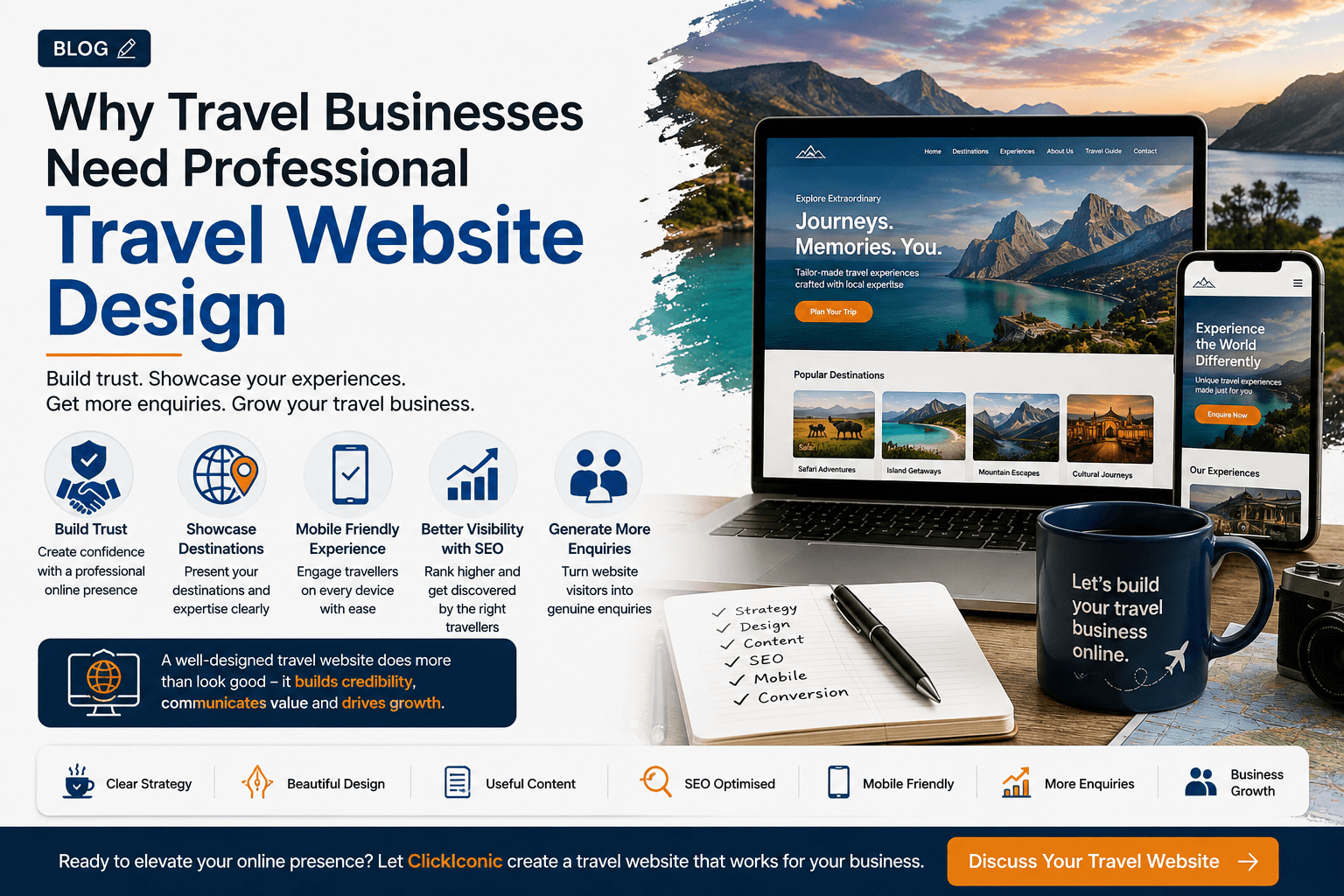
This is why Travel Website Design is not simply about making a travel website look attractive.
For travel businesses, the website has to communicate something that photographs alone cannot: confidence.
Travellers are often considering an experience they cannot physically see before they buy it. They may be travelling to another country, spending significant money, taking time away from work, or trusting a company to organise an important part of their journey.
Before they make that commitment, they want reassurance.
They want to know who you are, what you offer, whether you understand the destination, whether other travellers have trusted you, what the experience will look like, and what happens after they send an enquiry.
A strong travel business website brings these answers together in a way that feels clear, credible, and easy to navigate.
That is why professional website design for travel companies should be treated as a business investment rather than simply a visual upgrade.
Your business may already offer excellent tours, experienced guides, memorable photography trips, safaris, cultural experiences, or personalised itineraries. The question is whether your website communicates that quality strongly enough before the first conversation.
Your Website Creates the First Impression of Your Travel Business
Before a traveller asks you a question, they may already have formed an opinion about your business from your website.
Think about how a traveller researches a trip.
They may discover your company through Google, social media, a recommendation, a travel forum, or another website. The next step is often to visit your website and see whether the business appears legitimate, experienced, relevant, and worth contacting.
This makes the website an important part of the first impression.
If the homepage immediately explains what you offer, who you help, where you operate, and why travellers should trust you, the visitor has a reason to continue.
If the homepage is filled with generic statements, outdated photographs, unclear navigation, or information that takes too long to understand, the visitor has to work harder.
Travellers are comparing options. They do not have to stay on one website.
This is where a professional travel website can make a meaningful difference.
The purpose is not to impress visitors with technology or excessive animation. The purpose is to communicate the quality and personality of the travel business quickly and clearly.
Strong Travel Website Design should therefore answer an important question within the first part of the visitor's journey: "Why should I continue exploring this company?"
- ✓Clearly communicate the type of travel experience offered
- ✓Make the destination or travel focus immediately understandable
- ✓Use high-quality and relevant imagery
- ✓Show what makes the company different
- ✓Make navigation simple
- ✓Present important trust signals early
- ✓Provide a clear next step
- ✓Avoid unnecessary visual clutter
A website cannot replace the personal relationship between a traveller and a travel professional, but it can create the confidence needed to begin that relationship.
A Professional Travel Website Builds Trust Before the First Conversation
Trust is one of the most important reasons a travel business needs a professional online presence.
A traveller cannot experience your service through the screen.
They cannot meet your guide, inspect your vehicle, walk through your office, or experience your destination knowledge before making an enquiry.
Your website has to provide enough information and evidence to reduce that uncertainty.
A professional travel website can introduce the people behind the business, explain the experience, display genuine customer feedback, present relevant destinations, show previous work, and explain what happens after an enquiry.
These details may appear small individually, but together they create a stronger sense of credibility.
This is especially important for international travel. A customer may be booking from thousands of kilometres away. They need to feel that there is a real business behind the website.
A generic template with stock photographs and vague promises does not communicate the same confidence as a website built around the company's actual experience.
Professional website design for travel companies should therefore focus on authenticity as much as appearance.
The website should feel like the business it represents.
Ask Yourself
If a traveller discovered your website today and knew nothing about your company, would the website give them enough reasons to trust you?
- ✓Can they understand who you are?
- ✓Can they see where you operate?
- ✓Can they understand your experience?
- ✓Can they see evidence from previous travellers?
- ✓Can they understand what happens after they enquire?
- ✓Can they easily find your contact information?
Trust should not depend entirely on what you say about yourself. Your website should provide evidence that helps visitors reach that conclusion themselves.
Your Website Should Show Destination and Travel Expertise
One of the biggest opportunities for a travel business website is demonstrating knowledge that generic booking platforms cannot provide.
Travellers are not always looking for the cheapest available option.
Many want someone who understands the destination and can help them make better decisions.
They may want to know the best time to visit, which regions to combine, how long to stay, what type of experience suits them, what to expect during the trip, or how the itinerary can be adapted to their interests.
Your website can demonstrate that knowledge.
Instead of simply listing tours, a travel business can use its website to explain destinations, experiences, travel styles, itineraries, practical considerations, and common questions.
This creates a much stronger impression of expertise.
For a safari operator, this could mean explaining wildlife regions, seasons, safari styles, accommodation options, or the type of experience different travellers can expect.
For a photography tour company, it could mean explaining photography opportunities, locations, timing, group sizes, and the experience of travelling with specialist guides.
For a cultural travel company, it could mean showing the people, places, traditions, and stories that make the destination meaningful.
The website becomes more than a catalogue. It becomes a resource that demonstrates why the business understands the journey.
- ✓Destination knowledge
- ✓Travel experience
- ✓Specialist expertise
- ✓Local knowledge
- ✓Sample itineraries
- ✓Travel planning advice
- ✓Frequently asked questions
- ✓Unique experiences
- ✓Relevant destination content
The more clearly a travel company can demonstrate genuine expertise, the easier it becomes for potential customers to understand why they should choose that business rather than simply comparing prices.
Present Your Travel Experiences Clearly
Beautiful photographs can attract attention, but travellers need more than photographs before they are ready to enquire.
A strong travel website should help visitors imagine what working with the company will actually be like.
That means explaining the experience in enough detail without overwhelming the visitor.
A tour page, for example, should make the core experience easy to understand. Visitors should not have to search through several unrelated pages to discover what is included, who the experience is designed for, how long it lasts, or how they can ask questions.
The presentation should also reflect the type of traveller you want to attract.
A luxury traveller may be looking for comfort, personalisation, exclusivity, and attention to detail.
An adventure traveller may care more about activity, flexibility, challenge, and authenticity.
A family may need information about safety, comfort, timing, and suitability.
A photography traveller may care about locations, light, timing, group size, and specialist knowledge.
The website should therefore avoid presenting every traveller with exactly the same generic message.
Good travel website content connects the experience with the person who is considering it.
Do Not Make Travellers Guess
If an important question is likely to influence an enquiry, try to answer it clearly on the website.
- ✓Avoid hiding important information
- ✓Use clear headings
- ✓Use concise descriptions
- ✓Show relevant images
- ✓Use itineraries where helpful
- ✓Explain the next step
The goal is to help travellers move from "This looks interesting" to "I understand this experience and I would like to know more."
Use Content to Answer the Questions Travellers Actually Ask
Travel website content should be written around traveller needs rather than simply around the company's internal descriptions.
Many travel websites focus heavily on saying what they sell.
The better question is: what does a traveller need to know before deciding whether to contact you?
They may want to know about destinations, itineraries, accommodation, transport, timing, group sizes, inclusions, costs, preparation, cancellation policies, safety, and what happens after booking.
Not every business needs to publish every possible detail on every page. But important questions should have clear answers somewhere on the website.
This is where a strong travel website content strategy becomes valuable.
Content can also support search visibility. Destination guides, travel advice, itinerary explanations, frequently asked questions, and specialist articles can help the website become relevant to searches made by potential customers.
The important part is that the content should be genuinely useful.
Writing dozens of pages simply to insert keywords will not create a strong travel website. Writing useful content that demonstrates knowledge can help both visitors and search engines understand what the business is about.
The best content sounds like the business knows its travellers because it is answering the questions they genuinely have.
Write Like a Travel Expert, Not a Brochure
The website should help the traveller make a better decision rather than simply trying to persuade them to buy.
- ✓Be specific
- ✓Answer real questions
- ✓Use natural language
- ✓Share genuine experience
- ✓Avoid exaggerated claims
- ✓Use examples where possible
- ✓Make important information easy to find
Useful content can make a travel company more discoverable, more credible, and more helpful at the same time.
Design the Travel Website for Mobile Visitors
A travel website that works beautifully on desktop but becomes frustrating on a phone is not providing a complete customer experience.
Travellers use smartphones throughout the research process.
They may discover a company while travelling, compare destinations during a commute, check an itinerary from a hotel, or send an enquiry directly from their phone.
That makes mobile experience an important part of Travel Website Design.
The website should not simply shrink the desktop layout. The content hierarchy, navigation, buttons, images, forms, and spacing should be considered for smaller screens.
A traveller should be able to understand the core offer without constantly zooming, scrolling sideways, or searching for important information.
The enquiry process is especially important.
If a potential customer is interested but the contact form is difficult to complete on a phone, some of that interest can disappear before the enquiry is submitted.
Mobile design is therefore not only a technical requirement. It is part of the trust experience.
A smooth mobile experience tells visitors that the business has paid attention to how people actually use the website.
A professional travel website should feel intentional and easy to use whether the traveller visits from a laptop, tablet, or smartphone.
Build Travel Website SEO Into the Website
A beautiful travel website cannot help potential customers if they cannot find it.
Travel businesses operate in a highly competitive search environment.
People search for destinations, activities, tours, safari experiences, photography trips, itineraries, travel advice, and specialist experiences every day.
This creates an opportunity for travel companies that build useful, focused content around the topics their ideal customers are searching for.
Travel website SEO should therefore be considered during website planning rather than added after the website has already been built.
Each important page should have a clear topic and purpose.
A destination page should explain the destination. A tour page should explain the experience. An itinerary page should explain the journey. An article should answer a specific travel question.
This clear topical structure helps visitors and search engines understand the website.
Technical foundations also matter. Page titles, headings, URLs, internal links, image alt text, mobile performance, page speed, indexability, structured data where appropriate, and useful metadata all contribute to a stronger foundation.
However, SEO should not turn the website into a collection of awkward keyword repetitions.
For example, using the exact phrase "Travel Website Design" where it is genuinely relevant is useful. Repeating it in every paragraph would make the article unnatural.
The same principle applies to travel businesses. Create useful pages first and make sure search engines can clearly understand what those pages are about.
Good travel website SEO is not about filling pages with keywords. It is about making useful travel information easier for the right people to discover.
Use Real Trust Signals Instead of Generic Claims
Travellers are more likely to trust evidence than promises.
Many websites describe themselves as experienced, reliable, professional, passionate, or customer-focused.
Those words are easy to write.
The more useful approach is to show evidence that supports them.
A travel business can demonstrate credibility through customer reviews, testimonials, case studies, destination expertise, team information, experience, partnerships, professional credentials, photographs from real trips, and clear business information.
The exact combination will depend on the company.
A safari operator may benefit from showing guide experience, wildlife knowledge, traveller reviews, destinations, and real safari experiences.
A photography tour business may show previous trips, participant experiences, locations, specialist knowledge, and examples of the work produced.
A luxury travel company may focus on personalisation, service standards, partnerships, accommodation knowledge, and client experiences.
The key is relevance and authenticity.
A trust signal should help answer a question the traveller actually has.
Real Traveller Reviews
Genuine customer experiences can help potential travellers understand what it is like to work with the company.
- ✓Customer testimonials
- ✓Traveller reviews
- ✓Specific customer experiences
- ✓Third-party reviews where appropriate
Real experiences can reduce uncertainty because visitors can see evidence that other people have trusted the business.
Real Travel Experiences
Showing actual trips and experiences can communicate more credibility than generic stock photography.
- ✓Real destination photographs
- ✓Previous trips
- ✓Traveller experiences
- ✓Behind-the-scenes moments
- ✓Actual itineraries
Real experiences make the business feel tangible and help travellers imagine themselves taking the same journey.
Destination Expertise
Useful destination knowledge demonstrates that the business understands more than simply selling a package.
- ✓Destination knowledge
- ✓Local expertise
- ✓Travel planning advice
- ✓Seasonal knowledge
- ✓Specialist recommendations
Expert information can position the travel business as a guide rather than simply another seller.
Team and People
Introducing the people behind the business can make an international travel company feel more real and approachable.
- ✓Team profiles
- ✓Guide information
- ✓Experience
- ✓Specialist knowledge
- ✓Company story
Travellers often feel more comfortable when they know who they are trusting with their journey.
Clear Business Information
Transparency about the business and how to contact it can help visitors feel more confident.
- ✓Business information
- ✓Contact details
- ✓Professional email address
- ✓Location where relevant
- ✓Clear communication channels
Clear information helps visitors understand that there is a real business behind the website.
Turn Website Visitors Into Travel Enquiries
Getting visitors to your website is only part of the job. The website should also make it easy for interested travellers to start a conversation.
A visitor may spend several minutes reading about a destination and exploring your tours. If they then reach the end of the page and cannot see what to do next, the journey stops.
This is why the website needs clear calls-to-action.
For a travel business, the right CTA may not always be "Book Now."
Many travellers are still researching when they first visit the website. They may have questions about availability, itinerary changes, group size, dates, accommodation, destinations, or suitability.
A softer and more relevant CTA can make it easier for them to start the conversation.
Examples include "Plan Your Trip", "Request an Itinerary", "Discuss Your Trip", "Ask About Availability", or "Start Planning Your Safari".
The CTA should match the visitor's level of interest.
The enquiry form should also ask useful questions without becoming unnecessarily long.
A good travel website conversion path removes friction. It helps the visitor understand what happens after they make contact.
A Strong Travel CTA Should Answer Three Questions
The visitor should understand what they are being asked to do, why it is useful, and what happens afterwards.
- ✓What should I do?
- ✓Why should I do it?
- ✓What happens after I submit the enquiry?
The goal is not to force every visitor to book immediately. The goal is to make it easy for an interested traveller to begin a conversation.
When Should a Travel Business Consider a Website Redesign?
Not every travel business needs a completely new website. But there are situations where the current website is no longer supporting the business properly.
A travel website can become outdated even when the business itself is doing well.
The company may have expanded its destinations, changed its services, gained more experience, collected better reviews, or developed stronger travel products while the website still reflects an older version of the business.
That creates a gap between the real business and its online presentation.
A travel website redesign can be valuable when the current website no longer communicates the quality, expertise, or positioning of the company.
But redesign should not mean simply changing colours, replacing photographs, or adding animations.
The more important question is what the website needs to achieve that it is not achieving today.
A useful redesign can improve structure, content, navigation, mobile experience, trust signals, SEO foundations, enquiry flow, and overall clarity.
This is why travel website redesign should begin with understanding the business and its customers rather than starting with a new visual style.
Before Redesigning, Ask This
Do not ask only whether the website looks old. Ask whether it still represents the business accurately and helps the right traveller take the next step.
- ✓Does the website communicate what we offer clearly?
- ✓Does it show why travellers should trust us?
- ✓Does it demonstrate our destination expertise?
- ✓Does it work properly on mobile?
- ✓Can visitors find the information they need?
- ✓Does it generate relevant enquiries?
A successful travel website redesign should improve the business's digital presence, not simply give the website a newer appearance.
What a Professional Travel Website Should Ultimately Achieve
A professional travel website should bring trust, expertise, content, design, usability, SEO, and conversion together into one clear experience.
The strongest travel websites are not necessarily the ones with the most pages, the most animations, or the most impressive technology.
They are the websites that help the right traveller understand the business, trust the people behind it, imagine the experience, find the information they need, and take the next step.
This is the real purpose of Travel Website Design.
A travel company may have years of experience, strong local knowledge, excellent guides, memorable destinations, happy travellers, and genuinely valuable experiences.
But potential customers cannot automatically see those qualities from outside the business.
The website needs to make those strengths visible.
This is particularly important for travel businesses because the purchase decision often involves emotion and uncertainty at the same time.
The traveller is not simply asking, "What does this company sell?"
They are also asking, "Can I trust them with my trip?"
A professional travel website should help answer that question.
It should make the company feel real. It should communicate expertise. It should provide useful information. It should show evidence. It should make the experience easy to understand.
And when the traveller is ready to ask a question, the next step should be obvious.
This is where good website strategy matters.
Design attracts attention. Content creates understanding. Trust signals create confidence. SEO helps people discover the business. Mobile usability makes the experience accessible. Clear calls-to-action create a path towards enquiry.
At ClickIconic, we focus on helping trust-based service businesses build digital experiences that communicate credibility before the first conversation.
For travel businesses, that means creating a website around the actual business, the destinations it serves, the travellers it wants to attract, and the trust those travellers need before making contact.
The objective is not simply to create a better-looking travel website.
The objective is to create a website that makes the travel business easier to understand, easier to trust, and easier to approach.
- ✓Clear travel business positioning
- ✓Strong destination presentation
- ✓Professional visual design
- ✓Useful travel content
- ✓Easy-to-understand experiences
- ✓Real trust signals
- ✓Clear navigation
- ✓Strong mobile experience
- ✓Travel website SEO foundations
- ✓Fast and reliable performance
- ✓Clear enquiry paths
- ✓Relevant calls-to-action
- ✓Accessible contact information
- ✓Ongoing improvement
If you are a travel business owner, take a few minutes to look at your website as if you were a traveller discovering your company for the first time.
Can you understand what the company offers within a few seconds?
Can you see where the company operates?
Can you understand what makes the experience different?
Can you find genuine evidence that other travellers have trusted the business?
Can you understand what happens after you send an enquiry?
Can you comfortably use the website on your phone?
And when you are ready to talk, is the next step obvious?
If the answer to several of these questions is no, the problem may not simply be that your website looks outdated.
The website may need a clearer strategy.
Professional Travel Website Checklist
Travel Business Strategy
- ✓The ideal traveller is clearly defined
- ✓The primary travel services are clear
- ✓The main destinations are clear
- ✓The business positioning is understood
- ✓The main business goal is identified
- ✓The primary enquiry action is defined
- ✓The website reflects the actual business
Travel Website Structure and Content
- ✓The homepage clearly explains the business
- ✓Destinations are easy to find
- ✓Travel experiences are clearly explained
- ✓Itineraries are presented where relevant
- ✓Important traveller questions are answered
- ✓The business's expertise is visible
- ✓Travel content is useful and specific
- ✓Important information is easy to scan
- ✓Contact information is easy to find
Design and User Experience
- ✓The design reflects the travel brand
- ✓Visual hierarchy is clear
- ✓Images are relevant and high quality
- ✓Typography is readable
- ✓Navigation is simple
- ✓Important information is easy to discover
- ✓Buttons are visually clear
- ✓The website does not feel overcrowded
- ✓The design does not rely on unnecessary animation
Mobile and Technical Experience
- ✓The website works across mobile screen sizes
- ✓Mobile navigation is easy to use
- ✓Buttons are easy to tap
- ✓Travel enquiry forms work correctly
- ✓Images are optimised
- ✓Pages load efficiently
- ✓Links work correctly
- ✓Important integrations work correctly
- ✓The website has been tested across relevant browsers
SEO and Discoverability
- ✓Important pages have clear SEO titles
- ✓Meta descriptions are written
- ✓Headings are logically structured
- ✓URLs are clear and meaningful
- ✓Destination pages have clear topics
- ✓Relevant internal links are used
- ✓Images have descriptive alt text
- ✓Travel website SEO foundations are in place
- ✓The website is mobile-friendly
- ✓Important pages can be indexed
- ✓An XML sitemap is available where appropriate
- ✓Canonical URLs are configured where required
Trust and Conversion
- ✓Traveller reviews are visible
- ✓Testimonials are genuine
- ✓Real travel experiences are presented
- ✓Case studies or customer stories are available
- ✓Destination expertise is demonstrated
- ✓Team information is available
- ✓Business information is clear
- ✓Contact details are easy to find
- ✓Calls-to-action are relevant
- ✓The enquiry process is simple
- ✓Visitors understand what happens after enquiring
Frequently Asked Questions
Key Takeaways
- ✓Your travel website may be one of the first places a potential traveller decides whether to trust your business.
- ✓A professional travel website should communicate more than destinations and photographs.
- ✓Travel Website Design should combine visual quality with clarity, usability, credibility, and conversion.
- ✓Your website should demonstrate genuine destination knowledge and travel expertise.
- ✓Useful content can answer traveller questions while strengthening the website's search visibility.
- ✓Real reviews, traveller experiences, team information, and business details can reduce uncertainty.
- ✓A strong mobile experience is essential for modern travel research.
- ✓Travel website SEO should be considered during planning rather than treated as an afterthought.
- ✓Clear calls-to-action can help turn interested visitors into genuine travel enquiries.
- ✓A website redesign should improve strategy and customer experience, not simply change the visual style.
- ✓The strongest travel websites make the business easier to understand, easier to trust, and easier to approach.
- ✓Your website should communicate the quality and expertise that already exist inside your travel business.
Is Your Travel Website Doing Enough to Win Trust and Enquiries?
Your travel business may already have great destinations, experienced people, memorable experiences, and happy travellers. If your current website is not communicating those strengths clearly or generating the enquiries you expect, ClickIconic can help you identify what needs to improve across strategy, structure, content, design, trust, mobile experience, SEO, and conversion.
Discuss Your Travel Website With ClickIconic