
A beautiful destination can make someone want to travel. But a beautiful destination alone does not necessarily make someone choose your tourism business.
Before making an enquiry, travellers often spend time researching. They compare destinations, experiences, tour operators, reviews, photographs, itineraries, prices, and the businesses behind the experiences.
At some point, they usually arrive at a website.
That moment matters.
A visitor may land on your website after seeing a photograph on social media, finding you through Google, receiving a recommendation, or discovering your destination through a travel search.
Within a short time, they are trying to understand something very simple: Can I trust this business with my trip?
This is where Tourism Website Design becomes much more than colours, images, animations, and attractive layouts.
An effective tourism website needs to communicate the quality of the experience while also reducing the uncertainty that comes with planning a trip.
Visitors want to know where you operate, what you offer, who the experience is for, what makes it different, what previous travellers say, and what happens when they contact you.
If those answers are difficult to find, even a genuinely good tourism business can lose potential customers.
On the other hand, when the website is clear, credible, useful, easy to navigate, and built around the actual traveller journey, it can become one of the strongest assets of the business.
So what actually makes a tourism website effective?
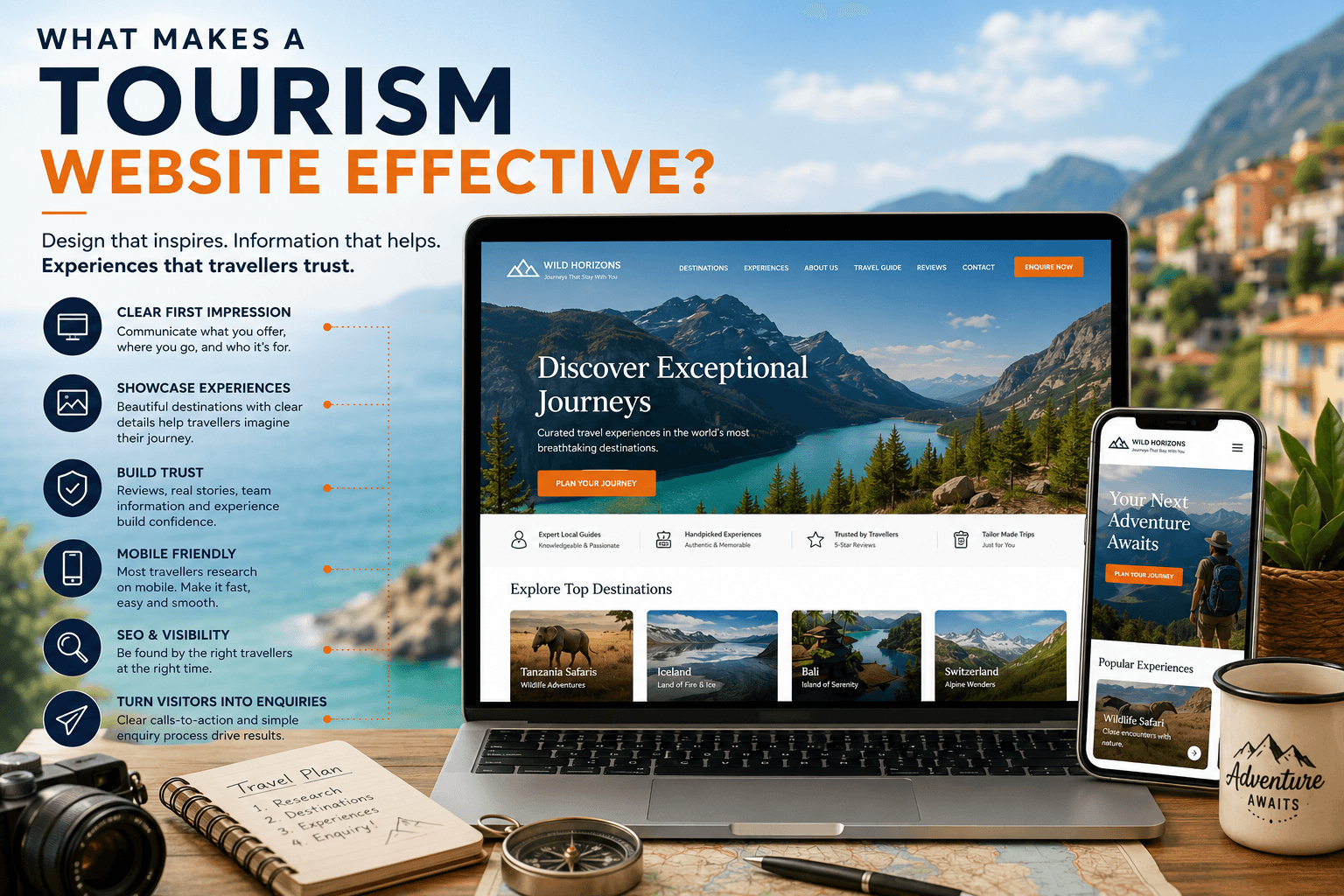
It is not simply having a modern design. It is about bringing strategy, content, visual presentation, trust, usability, SEO, mobile experience, and conversion together in a way that makes the business easier to understand and easier to approach.
1. Make the First Impression Clear and Relevant
The first few moments on a tourism website matter because visitors are quickly deciding whether they have found the right business.
A visitor should not have to work out what you offer, where you operate, or who your services are for.
The homepage should communicate the core proposition clearly.
Instead of relying on a generic statement such as 'Your Journey Starts Here', the website should provide useful context.
Visitors should be able to understand the destination, experience, or service being offered and why the business is worth considering.
A professional tourism website should create visual interest while maintaining clarity.
The hero section can use strong destination photography, but the image should support the message rather than compete with it.
The primary call-to-action should also be obvious. Depending on the business model, this could be 'Plan Your Trip', 'View Experiences', 'Request an Itinerary', 'Check Availability', or 'Talk to Our Team'.
The goal is not to make visitors click immediately. The goal is to make the next step feel natural.
Start With Clarity, Not Decoration
Before choosing colours, animations, or visual effects, define what visitors need to understand first. A strong tourism website starts with a clear proposition and then uses design to reinforce it.
2. Show the Destination and Experience Properly
Tourism is visual, but good tourism imagery needs context.
A gallery of beautiful photographs can create inspiration, but visitors also need to understand what those images represent.
The website should connect destinations with actual experiences.
For example, a safari operator should not only show wildlife photographs. The website should explain what travellers can expect from the safari, where the experience takes place, how long it lasts, who it is suitable for, and what makes the operator's approach different.
An adventure tourism business may need to explain activities, difficulty levels, safety considerations, equipment, guides, locations, and practical requirements.
A luxury tourism business may need to communicate accommodation quality, private experiences, personalised service, itinerary flexibility, and destination expertise.
This is where destination website design becomes more than simply placing large photographs across a page.
The website should help visitors imagine the experience while also giving them enough information to make an informed decision.
Use Images to Support the Story
Every important image should contribute to the visitor's understanding of the destination, experience, people, or brand. Avoid using photography simply because it looks attractive.
3. Build Trust Before the First Conversation
Trust is one of the most important elements of a tourism business website.
Travellers may be preparing to spend significant money on an experience they have never personally tested.
The website therefore needs to answer an underlying question: Why should I trust this business?
Trust can come from genuine customer reviews, testimonials, years of experience, destination knowledge, professional photography, team information, business details, partnerships, certifications where relevant, and real examples of previous experiences.
The people behind the business also matter.
A short team section can make a tourism company feel more human and accountable.
If the business has local expertise, specialist guides, years of destination experience, or a particular philosophy, the website should communicate it.
A tourism company website should not feel anonymous.
The more meaningful evidence a visitor can see before making contact, the easier it becomes for them to move from interest to confidence.
Show Evidence, Not Just Claims
Instead of saying that your business provides exceptional experiences, show the evidence behind that statement. Let customers, destinations, experiences, people, and business details contribute to the trust story.
4. Give Travellers the Information They Actually Need
Tourism website content should answer real questions rather than simply describe the business.
Visitors may want to know how to reach the destination, what is included, how long an experience lasts, what they should bring, when to travel, what type of traveller the experience suits, and what happens after they make an enquiry.
The exact questions depend on the tourism business.
A professional tourism website should therefore be built around the information visitors actually need to make decisions.
Useful content can also reduce repetitive questions for the business team.
When common questions are answered clearly on the website, enquiries can become more informed and conversations can start further along the decision-making journey.
This is particularly useful for complex tourism services such as custom itineraries, private tours, safaris, adventure experiences, and luxury travel planning.
Write for Decisions, Not Just Descriptions
Review your existing website and identify the questions customers repeatedly ask. Those questions can become valuable website content, FAQs, service details, destination pages, and supporting resources.
6. Design for Travellers Using Mobile Devices
Tourism research often happens on smartphones.
Visitors may discover a business while travelling, compare operators during a trip, save experiences for later, or contact a company directly from a mobile device.
A website that looks excellent on desktop but becomes difficult to use on mobile can lose valuable opportunities.
Mobile tourism website design should consider readable typography, simple navigation, clear buttons, fast-loading images, accessible contact options, and enquiry forms that are easy to complete.
The most important information should remain easy to find without excessive scrolling or complicated interactions.
Mobile performance also contributes to the overall quality of the user experience.
Visitors should not have to wait unnecessarily for large images, animations, or decorative elements to load.
Test the Website Like a Traveller
Do not only resize a desktop layout for smaller screens. Test the complete journey on a real mobile device, including navigation, destination pages, enquiry forms, calls-to-action, images, and contact options.
7. Build SEO Into the Tourism Website
Search visibility can be particularly valuable for tourism businesses because travellers frequently search for destinations, experiences, activities, and travel information before choosing a provider.
Tourism website SEO should therefore be considered during planning rather than added after the website has been designed.
Important pages should have clear titles, useful content, logical headings, meaningful URLs, descriptive image alt text, internal links, and strong topical relevance.
Destination pages can be useful when they genuinely help visitors rather than existing only to target keywords.
The same principle applies to experience pages, travel guides, FAQs, and supporting content.
Search engines need to understand what each page is about, while visitors need a reason to read it.
Good SEO brings these objectives together.
Keyword placement should remain natural. Repeating 'Tourism Website Design' or other target phrases excessively can make content feel artificial and reduce readability.
The strongest approach is to build genuinely useful pages around the topics potential travellers are searching for.
Create Pages Around Search Intent
Instead of asking only which keywords should be included, ask what information a traveller is trying to find. Build pages that provide a genuinely useful answer to that search.
8. Show What Makes Your Tourism Business Different
Many tourism businesses compete in destinations where visitors have several options.
If the website looks and sounds like every other tourism business, visitors may have little reason to remember it.
Differentiation does not always mean offering something completely unique.
It may come from local knowledge, a particular style of hospitality, specialist expertise, personalised itineraries, sustainability practices, photography expertise, family-friendly experiences, private tours, or a specific approach to customer service.
The website needs to make that difference visible.
A generic tourism company website often focuses heavily on what the business sells.
A stronger website explains why the experience is different and who will value that difference.
This is particularly important for luxury tourism website design and custom tourism website design, where positioning and perceived value play a major role in the decision.
Answer the Question: Why You?
Ask what a traveller would lose by choosing another provider. The answer can reveal the strongest positioning opportunity for the website.
9. Turn Website Visitors Into Tourism Enquiries
A tourism website should not simply inform visitors. It should make it easy for interested visitors to take the next step.
That next step depends on the business.
It could be an enquiry form, itinerary request, phone call, WhatsApp conversation, booking request, consultation, availability check, or email.
The call-to-action should match the visitor's level of intent.
Someone who has just discovered a destination may not be ready to book immediately.
A softer action such as 'Explore Experiences' or 'Plan Your Trip' can help them continue their journey.
A visitor who already understands the service may be ready for a stronger action such as 'Request a Quote' or 'Speak With Our Team'.
The enquiry process itself should also be simple.
Long forms can create friction, particularly on mobile devices.
Visitors should understand what information they need to provide and what happens after submitting the form.
Good tourism website conversion is about making the next step feel easy and low-risk.
Make the Next Step Obvious
Review every major page and ask what a genuinely interested visitor should do next. Then make that action visible, relevant, and easy to complete.
10. Know When Your Tourism Website Needs a Redesign
A tourism website does not necessarily need a redesign simply because it looks old.
The stronger reason is that the website no longer supports the business effectively.
An outdated tourism website may fail to represent the quality of the current experience.
It may also contain old information, work poorly on mobile, have confusing navigation, lack strong trust signals, or make it difficult for visitors to enquire.
Sometimes the problem is deeper than visual design.
The website may have grown over time without a clear structure, leaving important information difficult to discover.
A redesign can be an opportunity to rethink the complete traveller journey.
This includes content, information architecture, visual hierarchy, SEO, mobile usability, trust, calls-to-action, and conversion.
A successful tourism website redesign should improve how the website works for both the visitor and the business.
Redesign for the Customer Journey
Do not begin with the question, 'How can we make the website look newer?' Begin with, 'Where are visitors struggling, and what should the website help them do better?'
10.5. When Your Tourism Website Is Not Generating Enquiries
One of the most frustrating situations for a tourism business is having a website that receives visitors but produces very few enquiries.
The immediate reaction is often to assume that the website needs more traffic.
Sometimes that is true. But traffic is not always the main problem.
If visitors are arriving but leaving without taking action, the issue may be clarity, trust, content, positioning, user experience, or the enquiry journey.
Imagine a safari operator receiving visitors from Google every month. The website has impressive wildlife photography, but the homepage does not clearly explain the operator's expertise, the safari experience, or why travellers should choose that company.
The website may be attracting the right audience but failing to turn interest into confidence.
A similar problem can happen with a luxury tourism business. Visitors may like the photographs, but if the website does not communicate personalised service, accommodation quality, itinerary flexibility, and destination expertise, the perceived value may remain unclear.
An adventure tourism business may face another issue. Visitors may be interested in the activities but hesitate to enquire because they cannot easily find information about difficulty levels, safety, equipment, group sizes, or what they should expect.
In each case, simply increasing traffic may not solve the underlying problem.
The website needs to be reviewed as a complete customer journey.
Review the Journey Before Spending More on Traffic
If your tourism website is not generating enquiries, first identify where visitors lose confidence or become uncertain. Improving the customer journey can be more valuable than simply increasing the number of visitors.
The goal is not to make every visitor enquire. The goal is to make it easier for the right visitors to understand the business, trust the offer, and take the next appropriate step.
10.6. What to Look for in a Tourism Website Design Partner
Choosing a website partner is an important decision because the quality of the final website depends on more than visual design.
A strong partner should understand how tourism customers research, compare, evaluate, and enquire.
They should be able to look beyond the homepage and consider the complete website journey.
This includes positioning, information architecture, content, destination pages, experience pages, mobile usability, SEO, trust signals, and conversion pathways.
A tourism website designer should be able to translate the personality of the business into a digital experience without making the website difficult to use.
The same applies to tourism website development. Technical implementation should support performance, accessibility, mobile usability, SEO, and future growth.
If a business is considering tourism website redesign, the partner should be able to identify what is currently working and what is creating friction rather than simply replacing the existing visual style.
The best tourism web design decisions are connected to business objectives.
For example, a tour operator may need stronger enquiry pathways, while a destination-focused business may need better content architecture and search visibility.
A tourism website development company should therefore be evaluated on its ability to understand the business, not only its ability to build pages.
- ✓They start with business and customer goals
- ✓They understand tourism customer journeys
- ✓They can structure destination and experience content effectively
- ✓They understand the role of trust in tourism
- ✓They consider mobile users from the beginning
- ✓They understand SEO foundations
- ✓They can connect design decisions with conversion
- ✓They can explain why a particular structure or feature is needed
- ✓They avoid unnecessary complexity
- ✓They can build a website that reflects the business rather than using a generic presentation
Ask Better Questions Before Choosing a Partner
Instead of asking only how much a website costs or how quickly it can be built, ask how the partner plans to understand your audience, structure your content, improve trust, support SEO, and make the website generate better enquiries.
The right partner should not simply build a tourism website. They should help translate the business strategy and traveller journey into a digital experience that is clear, credible, useful, and commercially effective.
11. What an Effective Tourism Website Should Achieve
There is no single visual formula for an effective tourism website.
A safari operator, luxury travel company, adventure business, destination management company, and cultural tourism agency may all require very different website experiences.
What they should share is a clear understanding of the visitor journey.
An effective tourism website should make the business easy to understand.
It should help visitors discover relevant destinations and experiences.
It should provide useful information without overwhelming the user.
It should demonstrate credibility and expertise.
It should work well on mobile devices.
It should provide a strong technical and SEO foundation.
It should make important actions easy to find.
Most importantly, it should reduce the uncertainty that stands between a visitor and an enquiry.
That is the real purpose of Tourism Website Design.
Not simply to create a website that looks good, but to create a digital experience that helps the right travellers understand, trust, and choose the business.
Think Beyond the Website
Your website is part of the overall tourism customer experience. Every page should contribute to the visitor's understanding, confidence, and next step.
Tourism Website Effectiveness Checklist
Frequently Asked Questions
Key Takeaways
- ✓An effective tourism website should make the business understandable within the first few moments.
- ✓Tourism Website Design should combine visual quality with clarity, usability, credibility, and conversion.
- ✓The website should present destinations and experiences in a way that helps visitors imagine the journey.
- ✓Useful tourism website content should answer genuine traveller questions.
- ✓Real reviews, experiences, team information, and business details can strengthen trust.
- ✓Simple navigation helps visitors find information without unnecessary effort.
- ✓A strong mobile experience is essential for modern tourism research.
- ✓Tourism website SEO should be considered during website planning.
- ✓The website should clearly communicate what makes the tourism business different.
- ✓Relevant calls-to-action can help turn interested visitors into genuine enquiries.
- ✓A tourism website redesign should improve the customer journey rather than simply change the visual style.
- ✓The strongest tourism websites make the business easier to understand, easier to trust, and easier to approach.
Is Your Tourism Website Doing Enough?
Your tourism business may already offer incredible destinations, memorable experiences, local expertise, and excellent service. If your website is not communicating those strengths clearly or is not generating the enquiries you expect, ClickIconic can help you identify what needs to improve across strategy, structure, content, design, trust, mobile experience, SEO, and conversion.
Discuss Your Tourism Website With ClickIconic